Showing posts with label cemetery. Show all posts

Wednesday, August 06, 2014

Remnants of Early Life in Big Bend National Park

Before Big Bend was a national park, it was home to many hardy souls who worked to carve out a life in this isolated and beautiful part of Texas.  If you keep your eyes open, you'll see remants of buildings, homes, businesses, and graves belonging to those pioneers.  Want to read more? 

Links to more information on the park's website:

Original Settlers of Big Bend
Castolon
Hot Springs Historic District

Thursday, July 31, 2014

Socorro Mission and Cemetery

We'd like to encourage more travelers to get off I-10 and explore the Mission Trail area, just east of El Paso.  One of our favorite missions is one in Socorro, described on the Mission Trail Association website:

"The Socorro Mission exudes a sense of strength and dignity with its six-foot-thick adobe walls and massive vigas. The Socorro Mission shares the distinction of being among the oldest continuous settlements in the Southwest, as well as being one of the oldest continuously operated missions in Texas.

The original Franciscan mission, “Nuestra Señora de la Concepción del Socorro” was completed in 1691. Admired for its traditional adobe craftsmanship, unique design details, and for its role in resonating cultural heritage, the current Socorro Mission (dedicated in 1843) is listed on the National Register of Historic Places."

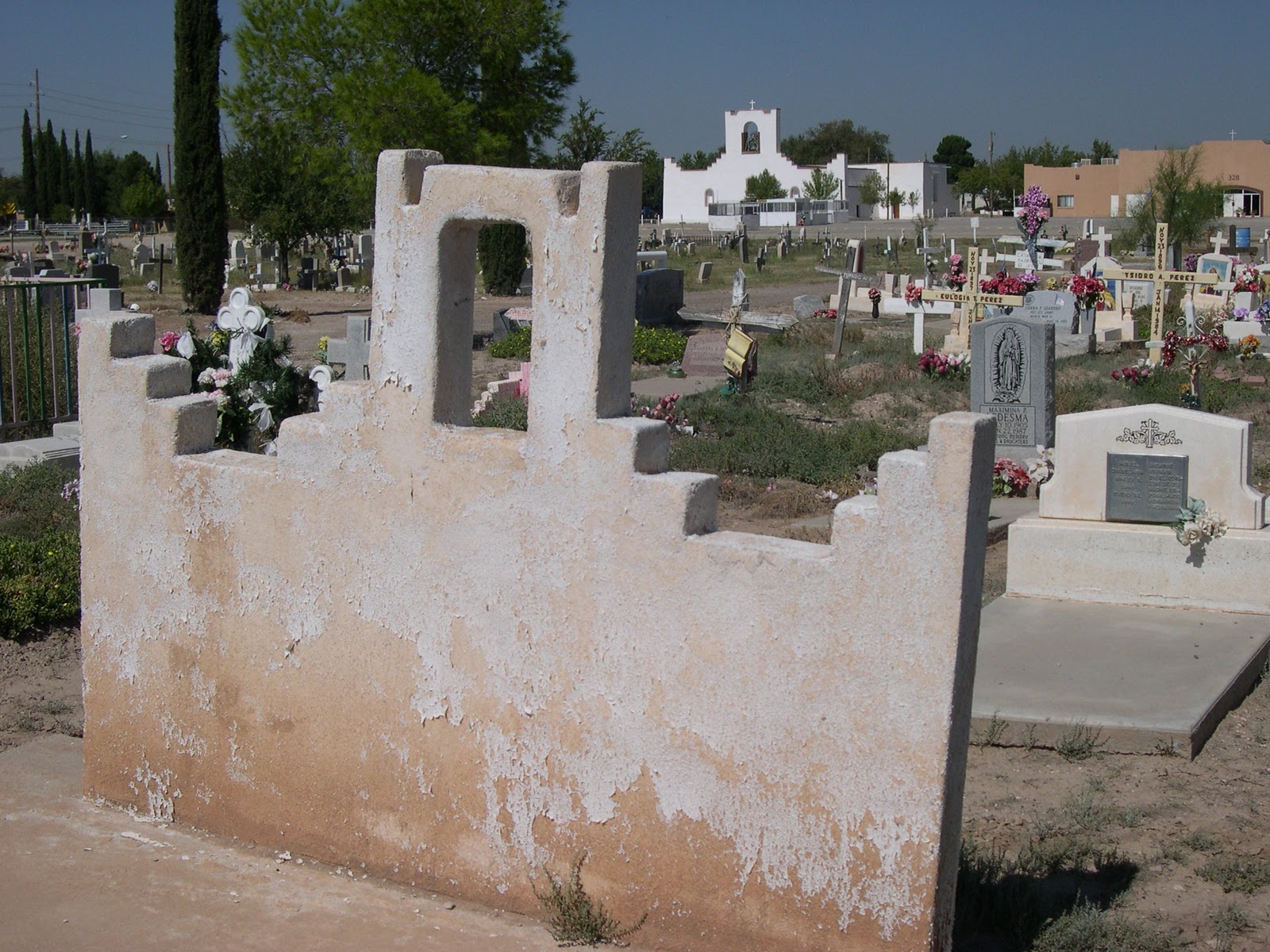
If you go, take a look at the nearby cemetery, with original grave markers, including this one mirroring the architecture of the mission.

Visitor information:

Address:  328 S. Nevarez Rd., El Paso, TX 79927
Hours of Operation:  10am-4pm (M-F); 9am-6pm (Sat); 9am-1pm (Sun)
For More Information: (915) 859-7718

Monday, December 30, 2013

Best of 2013: Cycling Marathon's "Ride to the Post" Heritage Bike Route


One of our Texas Mountain Trail Heritage Bike Routes is featured in the current issue of the Texas Historical Commission's magazine, The Medallion!   Click HERE to read the entire issue online--a travel article covering our region including Marathon, the Gage Hotel, and Big Bend Ranch State Park starts on page 6!

Is the route easy?  YES!  A family could easily handle the five miles there, five miles back route.  There's virtually no vehicular traffic, is incredibly scenic and the average slope is only 1.2%!  The elevation gain is only 121 feet! 


Why is this called a "heritage" bike route?  The ride starts out at the historic (and cycle-friendly!) Gage Hotel, continues across the highway and railroad (easy crossings!) to the Gage Hotel's formal Gardens.  From there, you follow signs to the Cemetery and County Park. 
Water Lily from Gage Gardens
The Cemetery is a short detour and has the graves of early Marathon residents, with interesting markings and monuments.


Head further south to Post Park, through country that once held a tent hospital during the 1918 influenza epidemic, a buffalo soldier encampment called Post Pena Colorado, and to Post Park. Be sure to read the interpretive panels on the Buffalo Soldier encampment and the geology of the area, produced by our friends at the Brewster County Tourism Council...and have a GREAT ride! 


Post Park!
The park itself is a great place to watch birds and enjoy wildlife, and was a stopping off point for the Comanche and Apache.  It also was a project of the 1930s Works Progress Administration!
Ride to the Post!

Friday, October 11, 2013

Come Anyway...Big Bend Alternatives

If you had plans to visit Big Bend in October, come anyway, despite the federal parks closures!  There are lodging and outfitter/adventure opportunities in Terlingua, Study Butte and Lajitas (www.visitbigbend.com is a GREAT resource) and Big Bend Ranch State Park is close by with PLENTY of room for visitors.  
Colorado Canyon River Access View
Big Bend Ranch State Park
Click for a closer view!
Hoo Doos along the River Road
Big Bend Ranch State Park
Why not visit the Terlingua Ghost Town Cemetery or the Starlight Theatre?  Now's the time to visit all those places near Big Bend...the places you've always wanted to try?


Tuesday, August 20, 2013

Terlingua Ghost Town Cemetery

Sometimes travelers just head to Big Bend National Park, and don't explore the region...that's a shame, because while they (without question) can get a GREAT experience in the park, there's just so much more to see and do.

Just west of Terlingua/Study Butte, along Hwy 170 (the River Road), follow the signs to Terlingua Ghost Town and the Starlight Theatre.  Soon you'll approach a small cemetery, the Terlingua Cemetery. 

The small cemetery located along the downhill slope of the Terlingua Ghost Town, a formerly abandoned quicksilver mining camp turned tourist destination and residential community for desert dwellers, may be one of the most photographed cemeteries in Texas.

No larger-than-life marble angels grace the gravesites here. Instead, modest filigree crosses, simple stonework, and small grottoes with hand-made embellishments highlight this historic burial spot, final resting place for miners who succumbed while digging for the highly toxic rare earth element known as mercury.

This tiny site, just over one acre, contains marked graves beginning in 1903, the year mercury mining production in this region began.

Click here to view an interpretive panel outlining the history of the Terlingua area mining operations, part of a great roadside history project by our partners at Visit Big Bend, and Brewster County Tourism Council.


The small cemetery located along the downhill slope of the Terlingua Ghost Town, a formerly abandoned quicksilver mining camp turned tourist destination and residential community for desert dwellers, may be one of the most photographed cemeteries in Texas. No larger-than-life marble angels grace the gravesites here. Instead, modest filigree crosses, simple stonework, and small grottoes with hand-made embellishments highlight this historic burial spot, final resting place for miners who succumbed while digging for the highly toxic rare earth element known as mercury. This tiny site, just over one acre, contains marked graves beginning in 1903, the year mercury mining production in this region began. - See more at: http://texasmountaintrail.com/plan-your-adventure/historic-sites-and-cities/sites/terlingua-cemetery#sthash.pPWYPknh.dpuf
Click here for more photos of the cemetery on the Life Before the Ruins website.

Click here for even more photos of the cemetery on the Big Bend Holiday Hotel website.


Important Announcement:  


FORT DAVIS, TEXAS – Beginning on September 3, 2013, Davis Mountains State Park will begin a temporary closure, which will last through March 1, 2014. Texas Parks & Wildlife staff will be performing major upgrades on the park’s utilities and systems during this time. Many of the park’s amenities, including the campgrounds, trails, and Interpretive Center, will be unavailable to visitors.

In addition to completing much needed utility projects, an extensive new trail system will be put into place in the Limpia Canyon Primitive Area. The current system, which consists of 6.5 miles of trail, will be improved and an additional 6 miles will be added to the existing route. The park’s new bird viewing area, which began construction in May of this year, will be completed, as well.

These improvements will add dimension to our park & provide additional opportunities for outdoor recreation for our park visitors. We are eager to unveil them when we reopen in the spring. 

Please note that the Indian Lodge and Black Bear Restaurant are unaffected by this closure and will remain open during standard business hours. The Indian Lodge office is open 24 hours a day and can be reached at (432) 426-3254. The Black Bear Restaurant is open Tuesday through Sunday from 7:00AM to 8:00PM, extending hours until 9:00PM on Fridays and Saturdays. Advanced reservations for the Indian Lodge can be made by calling (512) 389-8900.

Davis Mountains State Park and the Indian Lodge are located four miles north of Fort Davis on Hwy118N.

Thursday, November 01, 2012

Today is Day of the Innocents..Tomorrow is Day of the Dead

Grave in Terlingua Cemetery
Click photo to get a closer view
Permanent display recognizes
community Day of the Dead celebration
This time of year, many of our communities plan remembrances for past loved ones in Dia de los Muertos or Day of the Dead celebrations.  Terlingua, El Paso, Marfa have hosted celebrations, and visits to regional cemeteries reveal some private remembrances at the graves. Visit cemeteries around this time of year and you'll see evidence of recent care and objects left in memory of loved ones.

"In most regions of Mexico, November 1 is to honor children and infants, whereas deceased adults are honored on November 2. This is indicated by generally referring to November 1 mainly as Día de los Inocentes ("Day of the Innocents") but also as Día de los Angelitos ("Day of the Little Angels") and November 2 as Día de los Muertos or Día de los Difuntos ("Day of the Dead")," according to Wikipedia.

"People go to cemeteries to be with the souls of the departed and build private altars containing the favorite foods and beverages, as well as photos and memorabilia, of the departed. The intent is to encourage visits by the souls, so the souls will hear the prayers and the comments of the living directed to them. Celebrations can take a humorous tone, as celebrants remember funny events and anecdotes about the departed.
From a celebration in El Paso


Plans for the day are made throughout the year, including gathering the goods to be offered to the dead. During the three-day period, families usually clean and decorate graves; most visit the cemeteries where their loved ones are buried and decorate their graves with ofrendas (offerings), which often include orange Mexican marigolds (Tagetes erecta) called cempasúchil (originally named cempoaxochitl, Nahuatl for "twenty flowers")."
Altar in El Paso for Day of the Dead
Candles and marigolds left in front
of a Day of the Dead altar in El Paso

Monday, November 21, 2011

The Cottonwoods of Shafter

All around Shafter yesterday, the color was YELLOW.  The community's runoff areas and little streams are home to cottonwood trees, and they're in glorious fall color.

The Shafter Mining District was active from 1883 to 1952, taking silver and related ores from the area, and once again, Shafter's seeing mining again.  Drive into town and visit the cemetery and cemetery museum to learn more about the history of this small and proud community, on Hwy 67 between Marfa and Presidio.

And unrelated to cottonwoods or mining, but still pretty interesting.....

The town was also featured in the opening scenes of the 1971 science fiction film, The Andromeda Strain, where it played a small town in New Mexico.  Shafter's lovely church, pictured in our last photo above, can be seen (if you watch for it--glimpses of it near  0:35, 0:55 and 1:05!) in the film's trailer, above.

Saturday, March 05, 2011

Historic Shafter Cemetery

Yesterday, we showed a brief video of Shafter's beautiful church...today, we conclude Video Week with a short look at Shafter's historic cemetery.  It is located down an unpaved road and across a streambed from the church.  There's a small museum there, with plenty of interesting community and mining history.  Plan to visit this small, but fascinating place off Hwy 67 on your next visit to the Texas Mountain Trail region!

Monday, January 03, 2011

Socorro Mission on our Mission Trail


This is our second of five days this week featuring the El Paso County Mission Trail, and today we're showing Socorro Mission and the adjacent cemetery.  The building is on the National Register of Historic Places.

From the El Paso Mission Trail Association website, a bit of its history: "The Rio Grande played havoc on the locations of this charming mission.  It took its name from Socorro of the North (New Mexico).  The Piro Indians fled this area after the Pueblo Revolt of 1860 and established their new home.  Sixty Piro families along with fifteen Spanish families dedicated the mission to Nuestra Senora de Limpia Concepcion de los Piros de Socorro del Sur (Our Lady of the Immaculate Conception of the Piros of Socorro of the South).  
      In 2005 the mission completed a 10 year restoration that showcases some original cypress roof supports called vigas (beams) that were decorated by the Piro Indians.  The striking architecture reflects the vibrant local community with numerous historic haciendas within walking distance:  Casa Apodaca, The Bookery, Casa Ortiz, and Casa Carbajal."

See how the craftsman echoed the architecture of the mission in the grave's marker?  The Mission is still home for an active congregation, and a respectful stroll through the cemetery reveals a great deal about the community still using the mission as its church.

Tomorrow, we'll feature photographs from the restoration, plus provide a link to some neat 1936 photographs of the Mission now in the Historic American Buildings Survey in the Library of Congress!

You can visit the missions on your own, or take advantage of a new tour service...for more information, click here.

Note:  Wednesday is a special day for us, and we'll take a break in the series on the El Paso Mission Trail to celebrate our 1000th post in this blog!

Tuesday, November 16, 2010

Fort Davis' Pioneer Cemetery

Many travelers are intrigued by the historical marker on the outskirts of Fort Davis, on the road to Alpine, and the sign that says, "Pioneer Cemetery."  If you stop, and walk down the narrow sidewalk, between privately held property and a "Beware of Dog" sign, you'll be treated to an interesting old cemetery used from the 1870s to 1914.  The headstones are beautiful.  Some of them are hidden by high swathes of grass, thanks to this summer's plentiful rains.  Others are enclosed by iron fences and gates.  Visiting this place is one of those small adventures that are common in the region.  Enjoy!

Double-click on the photo to read the historical marker--it tells a couple of great stories!

Sunday, July 18, 2010

Shafter Cemetery

Shafter is an old mining town on the road from Marfa to Presidio, and while few people live there today, the signs of the old mining community are everywhere in town.  One of the interesting places to visit is the cemetery which has a small museum and tells the story of the area.

Thanks to Randy Mallory and the Texas Historical Commission for use of this photo!

Thursday, May 28, 2009

Flowering Cholla in the shadow of Six Mile Mountain

Van Horn's cemetery is a lovely spot in the shadow of the town's Turtleback and Six Mile Mountain. Right now so many of the flowers are in bloom, because of our summer rains.

Tuesday, May 12, 2009

Texans forever

Cemetery adornments offer a window into the hearts and minds of our west Texas communities. Many graves are decorated with articles that are purely Texan.

Saturday, April 04, 2009

Shafter Ghost Town Cemetery

Head south from Marfa towards Presidio, and you'll see a sign for the Shafter Ghost Town. Pull off here and follow the dirt road through the small community and across a streambed. Soon you'll see a sign for the cemetery. Take a moment to take in the mountain view, stroll through the cemetery and visit the small (but very interesting) community museum to learn more about this mining town's history!


Wednesday, January 28, 2009

Western Life

One of the clues to the values and culture of anyplace is the cemetery, and the small towns of the Texas Mountain Trail region are no exception. Take some time to stroll around the cemeteries in any of our communities and you'll see reflections of our western heritage and the closeness of families everywhere.

Tuesday, September 02, 2008

Football Season


One of the prettiest places to see high school football anywhere, is right at the Crossroads of the Texas Mountain Trail in Van Horn.
The stadium overlooks the cemetery (where Tommy Lee Jones filmed Three Burials of Melquiedes Estrada) and Turtleback and Six Mile Mountains.

Sunday, August 10, 2008

Chinese in El Paso


El Paso was the home to many Chinese railroad workers who chose to stay in that city after the railway was completed. Concordia Cemetery has a special section for those graves. You can read more about the Chinese in El Paso, here.

Friday, July 18, 2008

Frontier Cemetery in Fort Davis


On the edge of Fort Davis, on the road to Alpine is a seldom visited, but surprisingly delightful place. Park at the historic marker for the Frontier Cemetery, and walk down a narrow sidewalk to a long unused cemetery. Beautiful and interesting headstones await the visitor!

Thursday, June 26, 2008

Socorro Mission Cemetery

One of the not-to-be-missed places in El Paso County is the Mission Trail. The churches are the highlight, definitely, but take the time to absorb the cemeteries, the plazas, and the small communities along the Trail. Wander about...you'll be happy you took a slower pace.

You can download a brochure about the Mission Trail here.