Friday, February 08, 2013

Snuggling by the Fire in the Big House, Big Bend Ranch State Park

Many visitors to Sauceda, the historic ranch in the center of Big Bend Ranch State Park, point to the "Big House" and say, "I want to stay THERE."  Rustic elegance is there for you:  queen beds, bathrooms, a shared kitchen and the romance of an adobe fireplace in your room!  Built in 1908 and remodeled in the 1940s, the Big House is a terrific opportunity to step back into ranching history.  Don't expect city elegance...but DO expect a great experience, peace and quiet and beautiful sunrises and sunsets!
Fireplace in one of the guest rooms
 
Colored Mexican tile was installed in the 1950s by
Manny and Patricia Stewart Folkes

Shared kitchen with large windows (for viewing the sunset!)

Click here to see more pictures, and learn more about booking your stay in the Big House.  Make sure your vehicle is up to the rugged 27 mile ride to Sauceda.  The speed limit is 25 mph and you won't want to go any faster than that! Click HERE to read the park's flyer on a Walking Tour of Historic Sauceda Ranch!

 
Travel Spotlight: 
 
JOIN the Texas Mountain Trail!  Like the tips and travel ideas we post here every day?  Now you can get the inside scoop AND support our work, AND receive great benefits!  Click here to learn all about membership and make your tax-deductible contribution! 

Thursday, February 07, 2013

Rock Art in Big Bend Ranch State Park

Ancient peoples left pictographs in several locations in Big Bend Ranch State Park, and on a recent tour by TPWD's Blaine Hall, we saw some beautiful examples of rock art thought to date back 2,000 to 3,000 years ago.  To ensure preservation of the images, we'll protect the precise location.
 
 Read more about rock art in the park, here.  From the park's website:

"The earliest artifacts identified within BBRSP indicate that Native Americans traversed the area as early as perhaps 11,000 years ago, and continued to do so well into the 19th century. Native American site types attributable to the prehistoric era include open campsites, open camps associated with rock shelters, rock shelters, quarries, lithic scatters, Late Prehistoric Cielo complex (ca. A.D. 1250-1680) sites, rock art sites (primarily pictographs, or rock paintings) and special-use or ritual sites.
 
Many pictographs that have been recorded within the park are monochromatic red, black or white. Bichrome and polychrome (red, black, yellow, white) figures also occur. The figures include humans, animals, insects, tally marks, double zigzags, hourglass chains, star patterns and various other abstract motifs. Most of these pictographs were probably painted during the Late Archaic (ca. 1000 B.C. - A.D. 1000) or Late Prehistoric (A.D. 1000 - 1535) periods. Other pictographs represented by human figures on horses, longhorn cattle, Spanish saddles and crosses date to the Protohistoric (ca. A.D. 1535-1700) period or later."

Pictographs found in rock shelter in undisclosed
location in Big Bend Ranch State Park

Our adventure included driving very challenging roads
and hiking over very rugged desert terrain
to an undisclosed location in a remote area of the park
 (similar to this) to a rock shelter.

Interesting sun-like image centered in the
light blue circle (mid-right)
 If you're interested in visiting some rock art sites in the park yourself, there's one easily viewed set of pictographs on the road to Sauceda in the center of the park.  There's a rock shelter RIGHT by the road, and if you go slow, you can see some rubber mats on the ground and there's a new sign urging stewardship of the park's resources.  Stop there, get out of your car, walk along the rubber mats and look up at the shelter's rock ceiling...and soon, you'll see some pictographs! 

Or, you can hire a guide to give you a personalized archeology tour.  Page down on this link to read about "Ranger Programs."

TRAVEL SPOTLIGHT!
Now you can join the Texas Mountain Trail and support our programs, including this Daily Photo blog!  Our members receive terrific benefits and gifts are tax-deductible.  To learn more and become a member, click here!

Wednesday, February 06, 2013

Remote landscape shows evidence of early life--Metates

Near a remote landscape in Big Bend Ranch State Park
Last week, we visited extremely remote portions of Texas' wildest state park, Big Bend Ranch, with TPWD guide, Blaine Hall.  He took us to places we couldn't have found on our own, including this place in an undisclosed location where earlier people--possibly Comanche--made fires (notice the ash-colored ground in the photo below?) and ground grain on the metates.  To learn about the ranger-led programs and tours offered by the park, page down to "Ranger Programs," on this page.

Metates or grinding stones at the site
 
TRAVEL SPOTLIGHT!
Big Bend Resorts and Adventures'
Putting green behind the motel and
RV/Campground in Terlingua
Big Bend Resorts and Adventures
Close to the entrance of Big Bend National Park in Terlingua is Big Bend Resorts and Adventures, a lodging property with motel, RV and tent camping.  On our cycle-friendly list of properties, the folks at Big Bend Resorts also offer golf, horseback riding, and specialized tours of the area.  Don't want to take your own car down rugged park roads?  Let them do the driving (and the guiding) for you! 

Tuesday, February 05, 2013

Evidence of Earlier Life in Big Bend Ranch State Park

Down this trail in a remote park of the park, there's
evidence of wagon travel in this amazing landscape
 
Volcanic mudflow-type material in the foreground
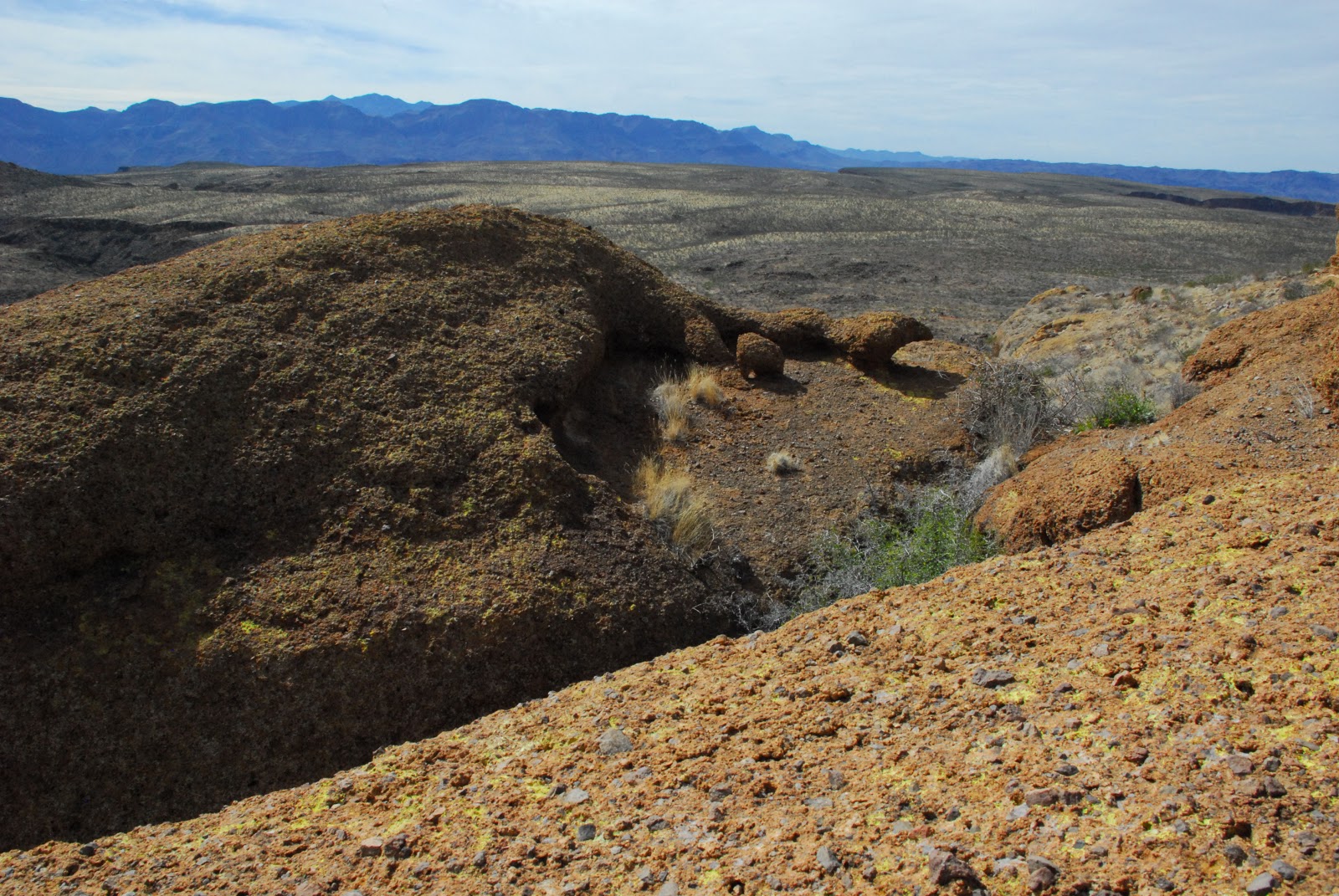
In the remote Guale Mesa portion of Big Bend Ranch State Park, there's an incredible landscape that offers many clues to the history of the park and the surrounding area.  The area near Guale Mesa #2 campsite is marked by a rough-textured rock surface that was once a volcanic-create mudflow-type material. The forms and shapes seem otherworldly and are immense fun to climb around and explore.  And the views, so near the Rio Grande and Mexico?  Spectacular!

As is the case in many parts of our region...if you look closely at ancient landscapes they can also hold clues to our more recent human history. 

The trail near the campsite is steep and heads DOWN...and what do we see?  Wagon ruts in the rock.

And this:
See the dark stripe in the center of the white patch?

 
Our guide, TWPD's Blaine Hall speculates wagons may have "slid" down the trail with someone riding the brake, and the teams following behind.  Metal wheels or metal covered wooden wheels made the ruts, still visible today.  The trail is too rough and too steep to consider traveling UP that routel, so teams probably used another route to get back to higher elevations.


Travel Spotlight:  JOIN the Texas Mountain Trail! 

Now you can get support our work AND get great benefits by joining Texas Mountain Trail as a MEMBER! 

Click here to learn how easy (and fun) it is to do just that!


Monday, February 04, 2013

Look UP at Night: Feb 2-23 Best Evening Viewing of Mercury AND Guide to Visiting McDonald Observatory

Photo by Randy Mallory for the Texas Historical Commission
Locals and veteran travelers already know it:  Our region has a distinguished jewel in McDonald Observatory.  Located atop the Davis Mountains on the "Scenic Loop," it is a place visitors regularly put high up on their bucket list.  Intrigued?  Here's an EXCELLENT article about visiting the Observatory and taking in a couple of their public programs, from our friend, Sheila Scarborough of Perceptive Travel Blog
 
Click here to read the Observatory's webpage on visiting the facility.  Heading to the region for Spring Break?  Click here to see all the special Spring Break programming at McDonald Observatory.
The view of the Davis Mountains from
the top of McDonald Observatory
(click on the photo for a closer view!)
This month, we'll be treated to the best evening viewing of Mercury in a long, long time.  Read more here, from Weather.com.  An excerpt:  "Mercury, the "elusive" innermost planet, will travel far enough from the glare of the sun to be readily visible in the western sky, soon after sunset. On the evening of Feb. 8, Mercury will skim within less than 0.4 degrees of the much-fainter planet, Mars."

Sunday, February 03, 2013

Henry Trost: A Touch of Genius in the Arid Southwest

Click image to enlarge and get details on this great event!
The Gage Hotel in Marathon is hosting a wonderful evening later this month.  Texas historian and Gage Hotel owner, JP Bryan will speak on the impressive career of architect, Henry C. Trost, who was responsible for some of our best historic hotels in the region.

 They include the Hotel Paisano in Marfa.

The Hotel El Capitan in Van Horn, now completely restored and open for dining and lodging.
The Holland Hotel in Alpine.
And the Gage Hotel in Marathon.
Click here for a list of historic hotels in our Texas Mountain Trail Region, and get your tickets for this great night at 432-386-4205.

Saturday, February 02, 2013

Concordia Cemetery, Buffalo Soldier resting place


El Paso is a city of surprising charm, and a diligent community of Texas heritage champions make it a wonderful city for discovering our past.  Take note of the Buffalo Soldier section of Concordia Cemetery.


Don't know about Buffalo Soldiers? Read this from our Texas Mountain Trail website:

"Buffalo Soldiers, a name the Plains Indians gave to the African American cavalry regiments serving the frontier after the Civil War, represent the genesis of the long struggle to integrate both the U.S. military and a society moving towards a more democratic union. Made up of both volunteers and draftees, the cavalry and infantry regiments-two out of four segregated African American regiments authorized by Congress-fought in the Indian wars, battling the likes of Apache, Comanche, and Sioux warriors.

Despite their courage and valor on the battlefield, Buffalo Soldiers received only moderately better treatment by the Anglo society than the Native Americans they were conscripted to fight against. Once the Indian Wars ended, Buffalo Soldiers continued to serve the military by fighting on several fronts, yet they suffered the afflictions of segregation along with the rest of the state's African American community. Although the two cavalry units were eventually disbanded, the remaining regiments continued fighting for the country well into World War ll. The final segregated regiment was disbanded in 1951 and its soldiers were integrated into units serving in Korea. Today, Buffalo Soldiers reside among the list of our most venerated warrior veterans and their heritage is celebrated with reenactments, literary accounts of their exploits, and in film.


Buffalo Soldier re-enactors at a TWPD event
Pictured above is the gate to the Buffalo Soldier Memorial in this special place.   Visitation information is here.

Click HERE to see "before" and "after" photos of this portion of the cemetery....its many volunteers have done a wonderful job honoring early African American soldiers in the region. 

Concordia Cemetery volunteers corralled the resources of many individuals and groups to honor the souls who contributed to the development of the region, including this group.


Travel Spotlight: 
Join our Texas Mountain Trail non-profit organization and get the inside scoop on traveling Far West Texas!  We're offering lots of great benefits too.  To learn more and to join, click here!   


Friday, February 01, 2013

Chisos Skyline, Big Bend National Park

Always, glorious views in Big Bend National Park.  Besides getting travel advice from our own Texas Mountain Trail non-profit, may we suggest you also visit www.visitbigbend.com when planning a trip to Big Bend?  Great information about that corner of our region can be found on their website!

Thursday, January 31, 2013

Reed by the Rio Grande

Even today, reed grows by the Rio Grande.  We took this photo along the trail at Hot Springs in Big Bend National Park.  Why is the reed important?

Consider this snippet from yesterday's post about Homer Wilson Ranch house in Big Bend:

"The double roof is supported separately by large poles.

The ceiling is made of reeds in the pattern that has been used for centuries by the inhabitants of the river. The story goes that Mrs. Wilson wanted the reed ceiling with the adobe mud on top, to-which Mr. Wilson agreed. However, since such a roof would leak, he used a 2-inch concrete mixture in place of the adobe mud and above that a sheet metal roof, thus making the house leak-proof. 

This arrangement not only accomplished its purpose but in addition made the house much cooler in the summer and warmer in the winter, as it created an air space between the metal roof and the ceiling. It was a very satisfactory means of insulation"

There may be invasive non-native species along the banks of the Rio Grande, but even they can tell us something about the plants' relationship with human life in such a remote place. What do you think?

Wednesday, January 30, 2013

What would it be like to LIVE THERE? Homer Wilson Ranch in Big Bend

Homer Wilson Ranch house far off in the distance
from the scenic overlook from Ross Maxwell Scenic Drive
in Big Bend National Park (click on the photo for
a closer view!)
Dwarfed by the majestic scenery, there's a historic ranch house standing in Big Bend National Park that is enormously effective in capturing our imagination.  What was life like on this wild land in the late 1920s when Homer Wilson established his ranching operation here?  Self-reliance, independence...it was a life requiring moxie and strong, strong character.

Even today, those characteristics are required of the backpackers who include a stop to the ranch house on the park's Outer Mountain Loop.  It is a three-day, 30 mile trip on a strenuous primitive trail and significant elevation changes.

From Ross Maxwell Scenic Drive pull-off, the ranch house looks like an oasis.  What was it like?

From the 1975 nomination form to place the ranch in the National Register of Historic Places:

Original Appearance: 

Although Homer Wilson maintained Oak Canyon as his headquarters, he "erected at this location (Blue Creek) a secondary and very substantial ranch house..."! "This house was 24 x 60 feet with 16 x 60-foot screened porch on the south side of the house. The house proper consisted of 2 bedrooms, a kitchen, and a large living room near the middle of the north wall. There is a large fireplace in which the mantle is made by very artistic placement of long slabs of stone placed horizontally. Some of these slabs are up to 8 feet in length and placed in a colorful arrangement.

The double roof is supported separately by large poles. The ceiling is made of reeds in the pattern that has been used for centuries by the inhabitants of the river. The story goes that Mrs. Wilson wanted the reed ceiling with the adobe mud on top, to-which Mr. Wilson agreed. However, since such a roof would leak, he used a 2-inch concrete mixture in place of the adobe mud and above that a sheet metal roof, thus making the house leak-proof. This arrangement not only accomplished its purpose but in addition made the house much cooler in the summer and warmer in the winter, as it created an air space between the metal roof and the ceiling. It was a very satisfactory means of insulation.

The interior walls carry little if any support for the roof, as this was done by sturdy poles set in cement and holding up the weight of the ceiling and roof. Practically all materials for the construction of the house came from the area. The stone, sand, and gravel came from Blue Creek Canyon, the timber from the Chisos Mountains, and the reed from the nearby Rio Grande. Thus the Blue Creek line camp ranch house may be said to be indigenous to the area. The floor of the house was made of well-selected flags while that of the porch was 'concrete.

In addition, to the house in the Blue Creek complex,  a small 1-room house for living quarters for additional ranch help, a small storeroom, an outside barbeque fireplace, a cistern to catch and hold fresh rainwater, a circular corral with a snubbing post for the training of young horses, and a nearby dipping vat and chute. There was also a chemical outhouse, a small chicken house, and a combination rock and tin structure likely used for the storage of salt and other equipment and tools,

Access to the Blue Creek house was over a reasonably well-maintained dirt road which came up the valley from Oak Canyon along the flats between Burro Mesa and the Chisos Mountains and then over the ridge into Blue Creek Canyon.


Present Appearance: Of the structures described above, all but the chicken coop still remain* Except for the storeroom and toilet, which are in poor condition, all are "structually sound, but deteriorating in detail."


More about Homer Wilson from the same document:

Homer Wilson was born in Del Rio, Texas, in 1892, studied mining and petroleum engineering at Missouri School of Mines, served in Europe during World War I, and returned to the Rio Grande country after the war. 

In 1929 he purchased ranch land west of the Chisos Mountains, and ultimately expanded his holding to include 44 sections to operate this vast tract he established his home and headquarters at Oak Springs. 

Later he moved part of his operations to Blue Creek. Wilson developed the ranch and raised his family-there during the years up to 1943 when he died suddenly. In 1942 he deeded the land to the State of Texas during-the early days of park land,-acquisition. 

The family moved from the ranch by the agreed deadline of January l,1945.  As one of the largest ranches in the Big Bend area, the Wilson Ranch has local significance. Its structures along with the natural setting provide opportunities to interpret twentieth century ranch life for this area.

Tuesday, January 29, 2013

Our Hospitality Heroes! Hyatt Place El Paso Airport

Danny Padilla (l), accepts the Texas Mountain Trail
Hospitality Heroes Award from Executive Director, Beth
Nobles (c), Director of Sales, Rebecca Diaz (r)
Every year, we award one or two regional businesses or attractions well-deserved special recognition, our Texas Mountain Trail Hospitality Heroes Award.

Our friends at the Hyatt Place El Paso Airport location have earned it!  They exemplify the best in hospitality and service--qualities that distinguish all our Texas Mountain Trail Hospitality Heroes Award winners.

The property was the first to participate in our cycle-friendly accommodations program, and was the launching location for Adventure Cycling Association's first Big Bend Loop tour last fall.  Click here to see their 2013 Big Bend tours...Adventure Cycling is  offering three Big Bend Loop tours this year, and they're visiting with the Hyatt Place about using their facility again.

The property has provided in-kind support that's allowed us to build partnerships and develop programs to bring travelers to El Paso and the rest of Far West Texas--like our Far West Texas Wildlife Trail, the Peak Fitness Challenge, and others.  In short, they've been an important part of every program we've launched.

Bike parking in rooms allowed
in this Texas Mountain Trail
cycle-friendly property!
From the early days of our organization, the Hyatt Place has supported our Texas Mountain Trail non-profit with leadership provided by Rebecca Diaz, their Director of Sales.  Rebecca served on our board for several terms, and is currently our Vice President and a member of our Executive Committee. 

All that support is most appreciated, but there's more:  without fail, the entire staff of this property is friendly, service-oriented and interested in providing the best stay possible for all its guests.  THAT makes our region just a little bit better for the traveler.   Congrats, and thank you!

Also, we'd like to note that we featured the menu items offered by the Hyatt Place for health-conscious visitors...check out our link to that entry!


Monday, January 28, 2013

Same Day: Sunrise and Sunset

Friday morning's sunrise captured by our friend,
Monte Riggs in Marfa
The same day's sunset, also captured in Marfa,
by our friend, Monte Riggs
Our region must be blessed with some of the best sunrises and sunsets anywhere.  Take for example, Friday's skies captured by our friend Monte Riggs in Marfa.  BEAUTIFUL!!

Sunday, January 27, 2013

Saturday, January 26, 2013

Hot Springs in Big Bend National Park

Big Bend National Park's David Elkowitz
(and a member of our Texas Mountain Trail board!)
gives a tour of Hot Springs

Hot Springs motel structure
View of current day visitors paddling to the Hot Spring
to enjoy a soak
One of the neatest places to visit in Big Bend National Park is the Hot Springs Historic District, which has evidence of ancient human history (in the form of rock art) and more recent history in the remnants of a Hot Springs resort, started by J.O. Langford when he moved to the Big Bend in 1909.  Read Langford's story:   Langford, J.O., with Fred Gipson. Big Bend: A Homesteader’s Story. Austin: University of Texas Press, 1973.

Read more about the historic district on the park's website.
Learn about taking a soak on your next visit!


Friday, January 25, 2013

Imagine farms of corn, beans, and squash in the river's floodplain

We took this photo on Saturday, at Big Bend National Park's Hot Springs Historic District.  This is the view from the remains of the historic Hot Springs resort motel.  Stay tuned for the next few days for images of this special place.

Along the banks of the Rio Grande, farmers on both sides of the river carved out a living growing beans, corns and squash in the sandy soil.

Learn about taking a soak yourself, just as tourists did in the 1920s through the 50s.

Take a look at the rock art left by ancient people.

Plan a visit yourself!

Thursday, January 24, 2013

Alvino House at Castolon in Big Bend National Park

Click on the image to get a closer view!  Notice Santa Elena
Canyon in the upper left, and the Alvino House on the right!
Explore the little paths in the park, and you'll be richly rewarded.  Down this path in the Castolon Historic District in the southwest part of Big Bend National Park, is the Alvino House, the oldest intact adobe structure in the park.  Built in 1901 by Cipriano Hernandez, a Hispanic farmer, it represents the everyday life of many of the families who lived and farmed along the Rio Grande.

From the park's website:

"Other Big Bend residents of Mexican descent chose not to work for local ranchers. They established homesteads and survived by subsistence farming and raising sheep and goats. These settlers developed ingenious methods for farming in the desert. Armed with an intimate knowledge of which plants could succeed in the desert climate, those who homesteaded near the Rio Grande or desert springs would use these water sources to irrigate their crops. Others, located far from water, farmed seasonally by locating their farms near washes and diverting water from flash floods during the rainy season. Many supplemented their incomes by harvesting candelilla, a desert plant from which they would render a fine wax, by baling hay and selling it to the local military and mining camps, by cutting and hauling wood to nearby settlements, or by trapping and trading furs at local trading posts."

And....

"The east end of the rambling adobe building now known as the “Alvino House” was the original Castolon store, where Hernandez vended his melons, pumpkins, squash, and beans"

In 1918, Alvino Ybarra moved into the house.  He earned his living by operating the engines that powered the cotton gin and water pump that brought water from the Rio Grande to irrigate the fields.  He was also a tenant farmer for the La Harmonia Company.  Alvino Ybarra continued living in the house until 1957, when he moved to Alpine.

Wednesday, January 23, 2013

Sotol Overlook in Big Bend National Park

This weekend, we got off the road as much as we could in Big Bend National Park.  And while the scenic drives are INCREDIBLE, there's nothing quite like getting out of the car and seeing what you can see on foot.  In this case, we didn't have to walk far, as the Sotol Overlook on Ross Maxwell Scenic Drive offered spectacular views...this one from the parking lot!  (What you're seeing in the blue distance is Mexico!)

Click here to read more about the places you can visit along Ross Maxwell Scenic Drive in Big Bend National Park! 

Tuesday, January 22, 2013

Visiting La Harmonia

Many visitors heading to Santa Elena Canyon in Big Bend National Park miss the Castolon Historic District just off Ross Maxwell Scenic Drive, right by the Rio Grande.  One of the most visited places in the district is the La Harmonia Store, where you can still go in and buy provisions, cold water and snacks, t-shirts, sunglasses and other sundries.  The building was built in 1919-20 to serve as a barracks for the U.S. Cavalry during the Mexican Revolution.  Shortly after the building was erected, the troops were withdrawn, and were purchased by Wayne Cartledge and Howard Perry, partners in the La Harmonia Company.
It doesn't take too much imagination to put yourself back in the 1920s, when the shelves were stocked with a wide variety of merchandise to cater to both American and Mexican citizens.  Right next door to the store, there's a little museum and bookshop designed to help visitors understand the Castolon area of the park.   The La Harmonia Company was vital to the survival of the remote villages in the area.  It remained in business until 1961, when it was sold to National Park Concessions and incorporated into the national park.  

Monday, January 21, 2013

Big Bend Vista, Friday afternoon

click on the photo to get a closer view!
Taken late Friday afternoon on the road heading out of Big Bend National Park towards Terlingua...just one of thousands of beautiful sights if you pull off the road every now and then and get out of your car!

Sunday, January 20, 2013

Join the Peak Fitness Challenge and Take a Heritage Hike!

In mileage, our #2 female hiker in the Peak Fitness Challenge
but #1 in enthusiasm!  Adrianna Weickhardt, Franklin Mountains State Park!

We're in the process of contacting all the winners, but we now have a list of the hikers/trail runners who logged the most miles in the Peak Fitness Challenge in 2012.  Those with an (*) asterisk have logged more than 20 miles on the Peak Fitness Challenge website, www.geobetty.com/peak :

Women
*Hannah Simmons
*Adrianna Weickhardt
*Abby Austin
*Laura Jones
*Lindsay Strelec
*Lynn Vasquez
Ashley Benisatto
Denise Martinez
Kristi Hines
Rachel Carrera
Lindsay Drysdale

Men
*Mike McCorgary
*Hector Zubia
*Don Baumgardt
*Dennis Vasquez
*Drew Stuart
Tony Esparza
Charlie Pruett
Caleb Law
John Moses
Nathan Stanley
Charles Russell

Most of these hikers have experienced trails we've designated as "Texas Mountain Trail Heritage Hikes," and they've experienced historic ranch homes, mine ruins, an airplane crash site, a canyon where a Texas Ranger was killed by cattle rustlers.  Take a look, sign up, hike the trails, and YOU will be eligible for a variety of prize drawings in 2013!

The Peak Fitness Challenge is an ongoing program, and a cooperative effort of our Texas Mountain Trail, GeoBetty.com (and PhiDev, Inc.), Guadalupe Mountains National Park and Franklin Mountains State Park!